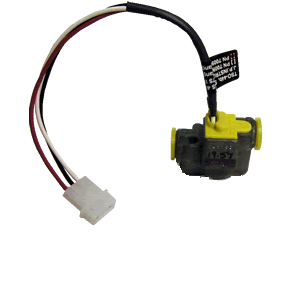
In an aircraft installation, fuel enters the transducer through one side and flows into a helical flow chamber. The fuel then exits vertically, allowing any vapor bubbles formed during operation to vent naturally. As the fuel moves through the chamber, its velocity is measured, and this velocity is directly proportional to the fuel flow rate.
Inside the transducer is a miniature, neutrally buoyant rotor precisely balanced on jeweled bearings. As fuel passes over the rotor arms, it imparts force that causes the rotor to spin.
An infrared light emitter is positioned on one side of the rotor, with a corresponding infrared detector on the opposite side. As the rotor spins, its arms interrupt the infrared beam, creating a pulsed signal. The frequency of this signal is used to calculate rotor speed and, in turn, determine the fuel flow rate. The design is simple, accurate, and highly reliable.
JPI fuel flow transducers utilize a more sensitive yet ruggedized version of this proven turbine-style technology, making them well suited for the wide range of operating conditions encountered in aircraft applications.